
Part 2 — Engineered Appetite
Most of us spent our entire childhood hating being told what to do. Fighting for independence. For choice. Now we’re adults—and we still hate being manipulated by friends, family, leaders. But somehow… we accept what we’re being fed.

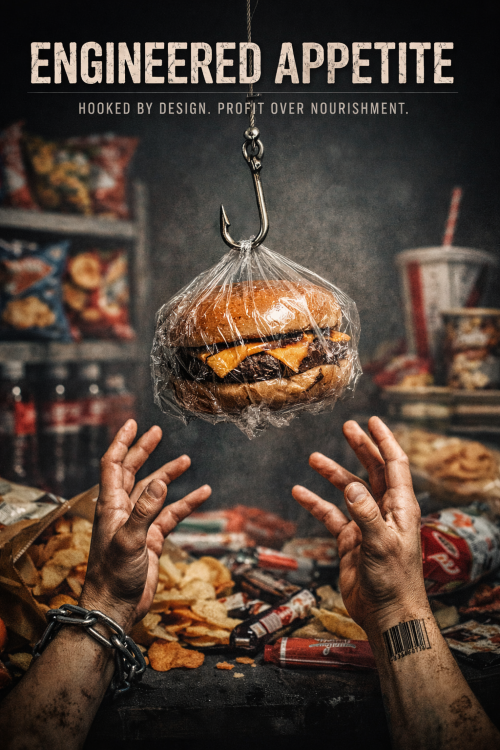
Audio: https://youtu.be/CfVdijsyOa8
This isn’t about food anymore.
At least not in the way we’ve been taught to think about it.
Because most of what we’re eating isn’t designed to nourish. It’s designed to keep you eating.
There’s a reason certain foods are hard to put down. Not because you lack discipline. Not because something is wrong with you. Because they were built that way. Engineered to hit something specific—salt, sugar, fat—in just the right combination. Enough to satisfy… but not enough to stop.
And maybe this is the part that’s hardest to sit with:
This might be one of the most effective systems ever built. Not to nourish you. Not to support you. But to keep you consuming—just functional enough not to question it.
And maybe the hardest part to admit—
this isn’t broken. It’s working exactly as designed.
Most of us spent our entire childhood hating being told what to do. Fighting for independence. For choice. Now we’re adults—and we still hate being manipulated by friends, family, leaders.
But somehow…
we accept what we’re being fed.
Literally. And figuratively.
Because food that truly satisfies ends the transaction. And that’s bad for business.
So what gets scaled?
Not nourishment.
Repeat consumption.
And over time, something shifts.
You stop eating when you’re hungry. You start eating when something is triggered. A time. A feeling. A habit you didn’t consciously choose. Bored. Stressed. Restless.
And the body gets quieter. Not because it stopped speaking—but because something louder took over.
So now the question isn’t: “Why can’t I control myself?”
It’s:
What am I interacting with that was never meant to be neutral?
Because your body isn’t confused. It knows what enough feels like. But if your appetite can be shaped, trained, engineered—then what you call craving starts to look a lot like conditioning.
This is where it turns.
Because once you see it, you can’t reduce this to willpower anymore. You have to look at the system. And your place inside it.
I’m not saying eliminate everything. I’m not saying become rigid.
I’m saying: pay attention.
Notice what happens after you eat. Not the taste—the feeling. The energy. The clarity. Or the fog.
Because once you actually feel the difference, some of this starts to fall apart. Not because you forced it. Because you saw it.
So sit with this:
If what you’re eating was designed to keep you coming back—how much of what you feel as hunger is actually yours?
What are you still consuming that you know isn’t serving you?
The Unscripted Mind
If this landed, share it.
Let it spark a question in someone else.
Just Breathe, The Unscripted Mind website.